McKenna Hutchinson
Creative Nonfiction Runner-Up 2026
“Can you grab me a C tank and take out the empty one from the car?”
This became a normal thing my mom would ask me before leaving the house. I was nine years old, walking around with an oxygen tank like it was just another backpack. As I grew older, I did more than just carry a tank: I hauled a chair from the first floor to the basement, wheeled the concentrator from hotel to hotel on family trips, making sure everything was ready before Mom even asked. None of my friends knew any of this. To them, I was just a normal kid: no oxygen tanks, no concentrator, no endless trips between Denver and hotels. Whenever anyone came over, Mom would quickly rip off her cannula and turn off her concentrator, as if hiding it could make our world feel normal again. I carried it everywhere, but always in silence, living a life that no one else could see. I learned to move quietly, to anticipate what Mom needed before she even asked, to keep the routine invisible. At school, I laughed and joked like everyone else, but at home, I carried more than just a tank, knowing that if I faltered, things could go wrong. And still, no one ever saw that side of me. It was mine alone, a secret life tucked into the corners of our home and the wheels of a small, unassuming concentrator.
When I was in third grade, just after we moved back to Billings from Williston, my mom went to the doctor more and more. I remember after school my brother and I would get picked up, go downtown to Billings Clinic’s pulmonology department, and sit in the waiting room for hours. The air smelled faintly of coffee from the little cart near the elevators and the sterile kind of smell that made your nose itch. The chairs were stiff-backed and scratchy. I sat swinging my legs, staring at the brown carpet patterns until they blurred together. My brother sprawled out across the chair next to me, bored and restless, sometimes pretending to fall asleep. The TV played western movies over and over, the same dusty horses and tumbleweeds, while I repeatedly glanced at the clock to see how long we were waiting. Every day it was the same answer: hours.
It all came to a head the day my dad returned from North Dakota because my mother was getting a lung biopsy. I have always been the kid scared of getting in trouble, but that was the one time I acted out. I remember the walk to the principal’s office after getting yelled at by my math teacher, tears welling up in my eyes. My dad picked me and my brother up from school, and I did not dare bring up my detention. We drove to the hospital, and there my mother was, lying in a hospital bed with a tube running out of her chest. The image never left me: the sharp antiseptic smell, the constant beeping of machines, and her trying to smile at us, hiding pain behind her eyes.
The biopsy was negative for cancer, which was a relief, but with that came a diagnosis that had no cure. Lymphangioleiomyomatosis, or LAM for short, is similar to cancer with uncontrolled cell growth, but it only affects the lungs of women of childbearing age. My mother never smoked a day in her life, but at forty, she now had to wear a cannula and carry an oxygen tank everywhere.
My mother never smoked a day in her life, but at forty, she now had to wear a cannula and carry an oxygen tank everywhere.
In the beginning, she was self-conscious about going out in public with her oxygen. At Target, we would do our shopping while we waited for the prescriptions to be filled. She had two kids under ten and walked around with oxygen. We would go down a busy aisle, then turn the corner to an empty aisle, and my mother would put her oxygen on and take a few deep breaths until she saw another person. I remember gripping the cart tightly, pretending not to notice. I could feel her embarrassment like static in the air, and I hated that I couldn’t do anything to make it easier for her. She would continue to walk down the aisle taking deep breaths, trying to take in as much oxygen from the air as possible. Her embarrassment rubbed onto me. I did not tell anyone at school that my mom was sick. It was weird to have a sick parent at such a young age. Later, embarrassment turned into self-preservation. I didn’t want to be defined by my mother being disabled. I didn’t want to feel their pity. I just wanted my mom to be normal.
As I got older, I was given more responsibility. My dad was always gone for work, and my brother, two years younger than I was, was deemed not capable enough. I started mowing our two-acre lawn with a riding mower in elementary school. I was so small that the first time I sat in the chair I moved it all the way forward and that was not even far enough, so I had to lean forward to get the mower going. The vibration rattled my teeth, and by the time I finished three hours later, my hair reeked of cut grass and exhaust. My legs would itch from the grass and bugs, and during the hundred-degree weather my legs would stick to the black leather seat. Over time I created my own routine with the mower: start in the front yard and go around the whole perimeter twice, then go into rows section by section, making wide turns and careful adjustments. That responsibility was mine until we moved out of the house my freshman year of high school.
A major part of going into high school was volleyball, which only added to the responsibilities I had at home. Even before the school year started, I went to the gym every day for weight training, then open gyms, then tryouts, and after making the team, practice. I still had all of my responsibilities at home, but now I also had to juggle daily practices after school and out-of-town games.
“I won’t make it to your volleyball game. I have an MRI and echo,” or, “I am not feeling the best, I won’t make it.” My mom always seemed to be gone. During high school, when everyone’s parents went to every game—even when Great Falls was four hours away—she never came. I would look up after a good save, scanning the stands for her, but she was never there. Other parents recorded their daughters’ games; the only videos I have from six years of volleyball were from my teammates’ parents. I never resented her, but it felt lonely riding the bus home at two in the morning, the hum of the engine filling the silence, watching yellow lines blur under the headlights.
My mother became better and better at scheduling her appointments around my brother’s and my schedules, but on too many occasions I was left to go with my grandpa to parent-teacher conferences or open houses, because my mom wasn’t feeling well.
When people asked what my parents did for work, it was always, “My mom is disabled. And my dad works in the oil field.” Short and simple.
*
I only really remember my mom as being sick. After her diagnosis, we started going on family trips. Her disease was progressive, worsening over time, with a lung transplant in the future. She always wanted to travel, and now the window to visit all the places on her list was growing shorter and shorter as time went on. So every year we went somewhere—Alaska, Hawaii, Mexico. Vacationing, as I got older, became more stressful. My father slowly started resenting my mother, so I was left to comfort her when her concentrator failed or when she ran out of oxygen and I had to run to the hotel room to find another one.
One night in Mexico, her concentrator failed in the hotel room. It was our first trip since her diagnosis, only six months prior. A constant beeping filled the darkness, indicating a loss of power. I looked over to my mom’s bed and saw her dark shadow move past me to the little light on the concentrator. There was a sharp beep, then silence. Some shuffling, then the beeping began again. The restart did not work.
“Why aren’t you working,” my mother whispered, pleading with the machine. She continued to mumble to herself and the machine. “Shit. Why does this always happen to me?”
I looked around the dark room: no movement from either my brother or dad. I slowly slid out of the covers and walked toward the movement of my mother’s phone flashlight. “What’s wrong?” I asked quietly, looking down at my mother on her hands and knees messing with the charger.
She jumped. “Shit, you scared me.” She grabbed her chest. “Nothing, Go back to sleep,” she said with exhausted eyes. I looked back to the beds. My brother started to squirm in my mother’s bed; my dad was still as a stone in my abandoned bed.
“Do you need help? Is your oxygen not working?”
“Can you go to the closet and find the plastic bag with batteries?”
I turned on the entrance light and started digging around in the bag designated for cannulas, humidifiers, and an array of different sizes of batteries.
“Turn off the light when you get it.” After finding and confirming it was the right battery, I walked back to my mother, keeping the light on despite her protests.
We tried everything that night to fix the beeping. For hours we switched batteries, charging cords, and outlets around the room. All with no change. The next solution was finding a whole new concentrator. A whole new lifeline for my mother. Normal families on vacation were asleep in the next rooms, recuperating from days at the beach and dreaming of what to do next, while my mother and I were up all night googling where to find a concentrator.
“I will just use one of my D tanks for the rest of the night.” We both finally went to bed hours after the first beep began. On the digital clock in between the two beds, the bright green numbers read 04:47. My dad still slept next to me, despite the hours of commotion occurring right at the foot of his bed.
This routine of concentrators malfunctioning on vacations became a normal occurrence, and I was always ready to give my support. Going from outlet to outlet, swapping battering and chargers to see if anything would work. Now on vacations my mother looked up where to find concentrators. We went to Tennessee and spent a day in an oxygen distributor. Even last summer, in Canada, my mom was on the phone for hours trying to find a concentrator, so for the remainder of the trip we traveled with a defective concentrator and the Canadian one.
*
During my parents’ divorce, my father was not allowed on the property, after a drunken night where my mother was forced to call the cops. That next morning I was dropped off for volleyball weight training, and my mother and brother went to the court house to get an order of protection. He was then served by the police and he left in his truck, never to return to the house.
With the divorce, my father’s gambling debt, and my mother not working, selling the house became inevitable. I was tasked with packing the house, moving things to my mom’s car, driving to the storage unit, and unloading. Over fifty showings took place my freshman year of high school. I vacuumed the house, mopped floors, and moved anything related to my mother’s oxygen into the garage. By the end, the house looked more like a model home than a lived-in one.
By the end, the house looked more like a model home than a lived-in one.
When our realtor, Rachel, first came to assess the house, she left a two-page list of tasks. My mother included me in the conversation, knowing I would be responsible for most of them. That summer, I packed up all the toys in the basement, remnants of years in Williston and our move. Legos, American Girl dolls, and countless plastic pieces went into boxes and eventually the car.
The basement was my domain. It was the one space I could keep clean. I would sleep in the bed, but that was it. My bedroom looked like the TV-show version of an elementary school-aged kid’s room—it had no personality.
Winter brought snow shoveling. Our four-wheeler had a plow, but it often broke, so I shoveled until the exposed skin on my fingers and cheeks burned and went numb. My boots were filled with snow. I would retreat inside to thaw my fingers before heading back out. In between breaks my mother would task my brother to help, but after a few minutes he would come in saying it was too heavy or too cold. My mother would assess his work, and every time she deemed him not good enough at shoveling. So after my break I would have to go over all of the sections he “did” and then finish the job.
In my mother’s eyes, my brother was the baby of the family who should not be in a situation like this, so it was better to have one child deal with all of this than both. At the time I did what I was told. I was fine with doing everything because that was the only option.
Afterward, I vacuumed my mom’s and brother’s rooms, swept and mopped the main floor, checked that the carpet looked freshly vacuumed, and carried my mother’s concentrator down the steps to the garage before jumping in the car with my mom, brother, and the dogs waiting for me.
We lived there for eight years, and I loved that house. But during the move, I was indifferent. I went through the motions. School, volleyball, packing. If I ever felt sad it was not for long. There was nothing I could change about my situation, so no point in feeling bad for myself. Now, whenever I drive past my old house, I am overcome by sadness. I lived most of my life there and I wish I could still be there now.
*
Volleyball became a balancing act. Morning weight room, packing, practice, more packing, homework late into the night. I developed the habit of waking at four in the morning to finish work I could not do after school. I would doze at the kitchen table with the one light on, everyone else asleep, the quiet house both a burden and a comfort.
One night around midnight my mother called me up the stairs. I had just gotten my license. She was experiencing chest pain. She was diagnosed with coronary artery disease a few years after her LAM diagnosis and scheduled for open heart surgery. A week before the scheduled surgery, she was taken to Denver and had three stents placed instead, eliminating the need for surgery, but, even so, chest pain needs to be taken seriously. I drove her to the ER, we went to the desk, all my mom needed to say was that she was having chest pain and had three stents, and we bypassed the full waiting room of people. I remember sitting there in the room with no windows, using two chairs to sit in, trying to get comfortable, while my mother sat across from me in the hospital gown with the EKG set up. It was 4 a.m. before the doctor came in and said it was not a heart attack but more tests needed to be done. They couldn’t find anything wrong with her, but I still went to school sleep-deprived and worried the whole day, while telling my friends nothing of what was going on.
*
I learned patience sitting in hospital waiting rooms for hours, watching strangers fidget and nurses shuffle papers. I learned responsibility when keeping the house spotless fell entirely on me. I learned empathy every time I comforted my mom, whispering encouragement when she was embarrassed or afraid. More than anything, I learned that strength does not always look like winning games. Sometimes strength is quiet. It is pushing a concentrator through an airport. It is staying up until four in the morning to finish homework. It is being the person someone else can lean on when the world feels too heavy.
People often say my story must have been hard or unfair, too much for someone my age. And it was. But it also gave me perspective and grit that I carry into everything I do now: school, work, relationships. I know how to handle pressure, stay calm when things go wrong, and put others first without losing myself.
It has been a little over ten years since my mom’s diagnosis. She now wears her oxygen everywhere. Slowly, over the years, she has had to increase the amount of oxygen she needs. This could be the reason she wears it everywhere, but I feel she’s just more comfortable with her disease. People frequently ask if she has COPD or emphysema, and she always gives the same answer: “No, it is a rare disease, with only a few thousand cases around the world.”
Each year my mom and I drive to Denver for her check-up, listening to BTS and arguing about which member’s concert is the best. Recently, she was deemed not sick enough for a lung transplant, which is good; lung transplants are considered the riskiest of transplants and have the highest rejection rate. After a transplant, a person has an estimated ten to twenty years to live, and without a transplant, still longer.
Now, years later, I can see how much those experiences shaped me. I don’t just remember the weight of the oxygen tanks or endless chores. I remember my mom laughing at the kitchen table, cannula tucked behind her ears. I remember the long car rides to volleyball games, humming to the radio and dreaming big. I remember the cold silence of winter mornings, breath clouding the air as I shoveled snow, and the quiet pride when the driveway was finally clear. I remember watching Naruto to escape my current situation. Sitting on the carpet in the basement with all the toys laid out in front of me, with my phone playing Netflix and my headphones on.
That is what stays with me. Not just the struggle, but the strength. Not just the weight, but the love that made me willing to carry it.
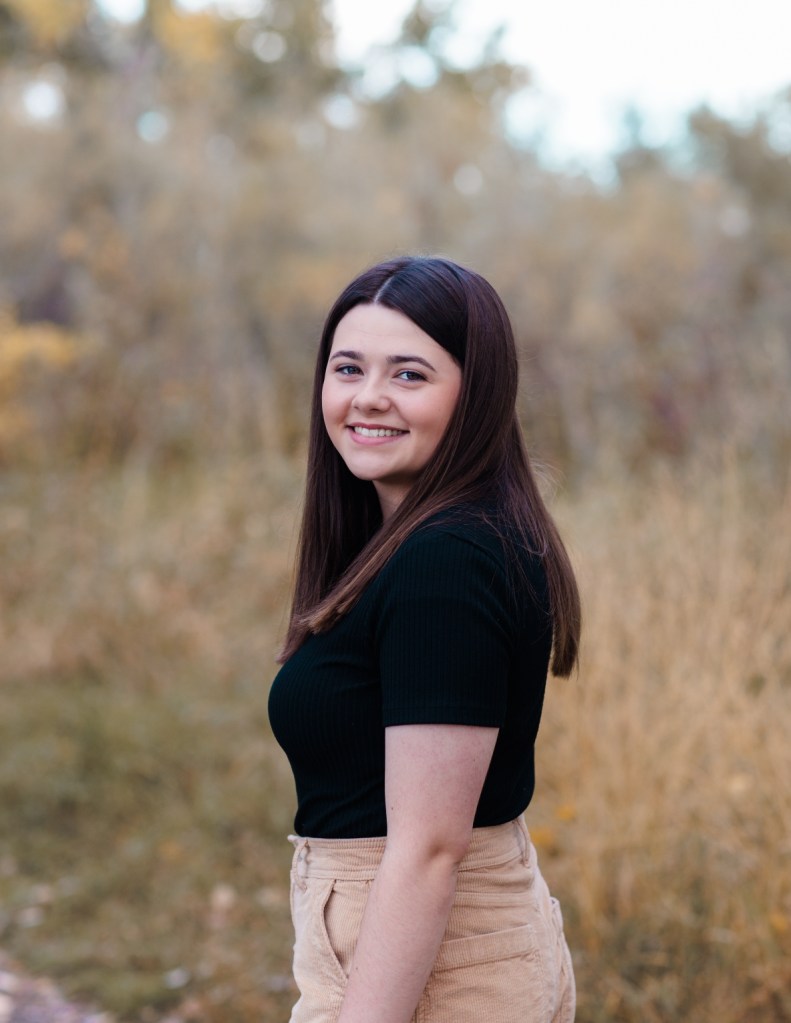
McKenna is a sophomore at Rocky Mountain College in Billings, Montana. She is studying biology and creative writing. McKenna is an avid romance reader with a love for science. She wants to be a physician assistant one day, and is currently working as an EMT.
 The Rocky Mountain Review