Abby Richardson
Fiction Runner-Up 2026
Gladys stood at her podium next to the guillotine, a gavel in her gray ceramic paw, her symmetrical body and watchful eyes waiting, watching. In Gladysymmetry, she held all of the power. She upheld the morals of the unjust in what she would assume was a just fashion. She would have never been caught dead in the robe of a judge—that would have gone against all of her morals. Too professional and false. And for what? Nobody would have questioned her authority. Not unless they wanted to be punished. She wore what she thought was up to her standard: a pair of navy and white striped trousers, suspenders of the same pattern attached with oversized white buttons, a floral undershirt, a collar resembling a doily, and a striped, oversized bow tie. The bigger the bow tie, the greater the authority.
Her large round eyes sat on each side of her head, almost giving her a full circle view. She glanced down a bit lower than her knee to see her loyal jester standing at her side. She liked him best out of everyone she ruled over, particularly because he couldn’t speak.
“Timothy, what has the subject walking up the deck done to be graced by my presence?”
Timothy looked up at her and shook his head, jingling the large bells attached to the two tails of his red and blue harlequin hat.
“That’s why I grace you with my presence. How pleasant you are, with nothing to say. But sometimes I really think you ought to be more expressive in your answers toward me.”
He took a tail of his hat in each of his hands, shaking them about, singing her a song she didn’t understand. She shrugged it off and returned her view upwards. An abundance of people stood motionless in a crowd, watching the splintered wood deck where someone of prey seemed substantially larger than them. Gladys looked at the man in shackles that had been taken up the numerous stairs to reach her platform; sweat rolled down his face and stained his clothes.
“What say you?” Gladys stared intensely at him with a grin creeping up her face.
“I was only sharing food with the homeless, ma’am. Honestly, I mean, unhonestly, or whatever you care the phrase to be. Your form, that is. Look, I didn’t want to see the poor fella suffer. I didn’t want to watch him croak.”
“Funny how you didn’t care to see him go, but here you are about to face your punishment. Isn’t it? Isn’t that funny?” She couldn’t help but laugh. She glanced at the crowd, signaling them to join in enjoyment of the man’s statement. They obeyed in a unison laugh, though their hearts were surely shriveling, their tongues dilapidated from lack of water—the punishment of a crime committed by the commoners responsible for farming on the previous Gladys Day of Praise. An insufficient haul of vegetation for their ruler, ended in a drought.
“Now my form shouldn’t be a problem for any of you, so don’t worry your little head about that,” she chuckled. “Oh, your little head. That is funny. It’s funny because your little head would look so fine in my collection.” She continued to laugh. She gasped for air from her own joke, before suddenly dropping her face to a frown. “My form is a standardized language that everyone should know. Hence why it is the form. The form you will all abide by. Watch out for your mishaps. I know I do.”
“Yes, ma’am. I’m sorry, ma’am.”
“Did I say you could speak? Did I say you should apologize?” She paused for a moment, and a grin curled at the corners of her mouth. “Did I ever say that charity was just? That taking pity on another was okay?”
“Well, ma’am, I—”
“A-a-a, no talking!” she rang in a cheery voice. “You could learn a thing or two from Timothy,” she snorted. “Now, what I suppose you want me to do is take pity on you, but that’s the one thing I couldn’t possibly justify. You made a mistake, and I think you need to face the consequences rather than run your mouth. Guards!” She clanked her ceramic paws together.
“No! No, please! I promise I’ll do better.” He paused for a moment in sheer panic before continuing. “Or worse, or whatever the phrase may be to please you. I’ll stick to the forms! Your forms! Please!” the man cried as he was dragged to the guillotine by chains.
The little guards pulled with all the might they had built up in their cottontails. Their noses twitched with determination as they tugged with their buck teeth that looped over the chains. The man tried to scramble away, but the rabbits were stronger, and his head was placed in the opening under the blade. With a swift pound of the gavel upon the chewed aspen podium, the blade was dropped and his fate decided. As the man’s body popped, Gladys rushed over to the woven basket where the man’s head rested. She picked it up and readjusted his mouth into a smile. She held onto his hair to raise the trophy up high for the crowd to gaze upon. It was the only part of a human body she willed to not disappear. The crowd cheered while some fought back tears, water that they couldn’t currently spare. The man’s body slowly deflated until he was an empty vessel surrounded in clothes. A couple of minutes would go by, and he would completely dissolve and be mopped up. His liquid form would be used for compost to grow Gladys the most delectable carrots. She shared the delicacy with no one, not Timothy, nor the guards.
As the man’s body popped, Gladys rushed over to the woven basket where the man’s head rested.
“That ends the day. Be gone with you all!” She called over the crowd, the head held nonchalantly under her arm.
Gladys and Timothy were escorted by the cottontails back to The Burrow, where they resided. The Burrow was an underground tunnel system owned and operated by Gladys and the cottontails. They could travel anywhere under Gladysymmetry and had the ability to communicate with each other by thumping their feet on the soil, each vibration being translated into a form. Her form.
Gladys sat on her bed, a lump of moss that she spread across the dirt floor. Timothy stood in front of her miming and jingling. He tried to explain to her that what she was doing was wrong, how her actions were unjust. He wanted her to realize that the morals she upheld were, in fact, immoral, but her perfection wouldn’t let her realize. She was too symmetrical, too faultless to listen to such foolery as suggested by him. He was just a form of entertainment to watch as the day passed on.
“Timothy, I know where you’re coming from. I completely understand how you would be so jealous of my collar, but it just wouldn’t fit you. I mean, if I had pockets, you could live in one. I’m just the bigger person,” she laughed, her nose twitching as she squeezed her eyes shut.
He glanced down at his bare porcelain feet, then past his silk jumpsuit to his fragile hands, up to his doily collar that was just his size, and finally up toward Gladys’s tall ears. He rolled his eyes and shook his head back and forth. Talking sense to her was no use, but he was determined to make her listen.
He picked his hand up and watched himself point his index finger, curling the others into a fist. You could see it in his animated movements: Timothy had just gotten an idea. It was as if an imaginary light bulb floated above his hat. He bent to the ground and dug his finger into the earth. Gladys ended her rambling and redirected her attention to Timothy.
“Goody, a little game! Timothy, you humor me so.”
He began to draw a rectangular figure, a basket at the end of it, and a stick man’s head, frowning while in containment.
“Aw, Timothy. That’s our favorite spot in all of my land! The Deck-laration of Fates!”
He nodded, jingling, and redirected his focus back to his art. He drew a circle around the drawing and a line through it.
“Stop with the guillotine? You want me to try another way of execution? Oh! I know! Maybe some sort of torture device? I’ve wondered what it would be like to watch someone pop after being stretched to their full potential. What do you think?”
He frantically shook his head, sounding an alarm of bells. He went back to the dirt and spelled out the word STOP.
“Hey now, Timothy,” she spoke in a stern voice. “That word is not in the form for anyone to use but myself. It is standardized. And I’m pretty sure that you can’t spell out words in this game. I would know because I made the game, and so I make the rules. You see?”
He smiled nervously at her, not wanting her to lash out, but not necessarily feeling afraid because of the ranking that she gave him above others. He pushed his luck further and wrote “UNJUST.” Gladys thumped her foot, a noise that could be heard by everyone underground as well as above—an unnatural earthquake, and a sign that she would soon have a tantrum. Timothy ignored it and kept writing. “PLEASE LISTEN TO ME.” Gladys thumped her foot faster, heavier. The cottontails dug deeper to get away from the booming wrath. “WE CAN FIX THIS.” An unforeseen and undeserved punishment would surely take place for the commoners afterward. “GLADYSYMMETRY IS WRONG.” Gladys had enough. She flared her nostrils, hissed, and lunged to the ground. She grabbed Timothy and shook him, forcing a chaotic chorus of jingling. It gave her pleasure to hear the sound of chaos and violence. She impulsively threw him to the ground and heard him crack with a thump of her foot. There was a shatter, not the usual pop. Timothy’s porcelain body spread in miniature fragments crushed into the earth, a non-compostable mixture of pollution.
Gladys scooped up his remains; they scratched the surface of her ceramic paw. Her blood smeared onto his small pale pieces. Why did she have blood, while Timothy didn’t? She had subconsciously made herself more human than him. His hand was still intact, still pointing. It was pointing straight at Gladys. Her ear folded, her symmetry broken. She felt something foreign in his death. Not pleasure, or laughter, or the craving to inflict the same death upon another. Was it because he didn’t pop? Because he didn’t deflate? Because he wasn’t compostable? Why did her heart hurt? Since when did she have a heart? She used to be an empty vessel, living off power and perfection. Her knees felt weak and she crumbled to the ground, weeping. Timothy’s hand still pointed at her. She had done this to him. It was her fault.
Gladys grabbed Timothy’s hat off the ground and slipped his shards into it. She sat there, tears blurring her vision, picking up each individual piece until the soil was pure again. By the time she had finished, his hat and jumpsuit were two sacks of limbs and fragments. She thumped for the guards to return and they reluctantly obeyed. They gasped at the sight, in disbelief that she would harm Timothy, her most prized possession. But more than that, they were seeing her feel sorrow and pain; they could hear her heart beat.
“Reassemble him at once,” she wailed.
The cottontails gently took the silk sachets of porcelain pieces, attempting to recreate life. The mock-up of Timothy’s body laid on her moss bed and waited to be glued together. The guards were even so gracious as to bring him flowers, not knowing if he could be revived. They wanted him to be comfortable. They realized what his jingles had meant. For them, cracking the code wasn’t much harder than following the form of thumps. Most importantly, they wanted him to know how appreciated he was for causing a change in Gladys. Her morals completely reversed as she preached the teachings she learned from Timothy. She decreed that everyone follow what she called the Timmorals. She even deconstructed the Deck-laration of Fate, sanding down the wood, and building homes for homeless commoners. In return, all she asked was for them to learn to make glue.
The commoners did all they could to create the substance and show their gratitude. They created resin from plant secretions and formed a glue that could bind Timothy’s remnants together and allow him to move. Each piece of Timothy was glued with care by Gladys, her hands now soft and covered with gray fur of balanced neutrality. Cracks ran across every surface of his skin, except his pointing hand. The hand pointed back at her as she finished gluing him together. She rebuilt him. He blinked. She recreated his life and willed the good to return.
“I knew you could do what was right.” Timothy not only spoke, but also pounded in his heart.
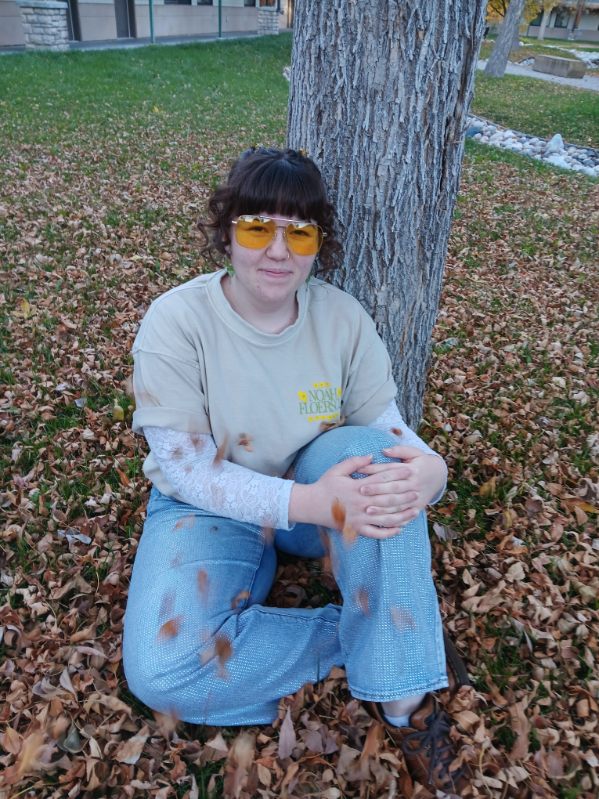
Abby Richardson is a sophomore from Bridger, Montana, double-majoring in creative writing and theater. She hopes to one day write screenplays and become a published author. A lot of the inspiration for her pieces comes from real people (and ceramic beings) in her life. She collects vintage yearbooks, loves plants, and saves worms off the sidewalk when it rains.

