Pamela Merrell
Creative Nonfiction Runner-Up
In 1993, home was a trailer park along the Bitterroot River, just north of Hamilton, a corner of the community so ugly, it was tucked into the trees. The latchkey kids in the park shared traumas of bruised eyes, fat lips, circular burns in covered places, and an appetite for elsewhere. We were trailer trash, last week’s unsightly heap that littered the streets every time the wind blew. School was our escape from being nobodies; on the playground at recess, we were dinosaurs, birds, and mythical creatures. We found family in each other.
That winter, during Christmas break, we emancipated ourselves from cigarette-infused air to the snow-covered basketball court. We built a snow wall high enough for our little army to crawl safely to the riverbank, undetected, like a platoon under enemy surveillance. For most of us, walking on the frozen river was forbidden, except for Adam. He was a transplant from Collier Heights, Georgia, after his parents died. His grandparents lived in the trailer nearest the river and allowed him to ice skate on its glass-like surface.
Jason did not allow me to be on the frozen river, so I navigated the river’s edge. Ice encased the rocks along the bank just enough so that they did not roll under my feet but became foreign terrain. The other kids fooled around on the ice while I stood safely on the bank, like a sentinel, and listened for any aches from the ice.
Adam called out to me, “They ain’t gon’ see us! Whataya scared of?”
Lucielle—she had a nasty bite when swung onto skin; her diamond embellishments permanently left their marks on the back of my thighs and buttocks. Lucielle was Jason’s thick, brown leather belt that enforced his consequences and expressed his anger.
I rubbed my back end. “If I’m caught, I won’t sit for a week!”
“Chicken! Bock! Bock!” The others joined, imitating poultry.
Pressured, my white Reeboks made the first glide on the ice, and I forgot about Lucielle. We played Red Rover, even with the great challenge to remain upright, running through the other team’s human barrier. Sneakers don’t fare well on ice.
“Red Rover, Red Rover, send Pamela on over!”
I dropped my hands from the hold of my teammates; my feet stuttered as they started on the slick surface and failed to propel me forward. I stomped to gain traction as I ran toward the line. I did not reach my opponent’s chain; instead, the ice broke, and the river pulled me into it. The subzero temperature forced my lungs to scream, and water invaded. I don’t remember thrashing or screaming, just the sharp, heavy ice in my lungs that prevented inhalation. First responders saved my life, and the Marcus Daly intensive care unit nursed me for eight days, treating the pneumonia.
Homecoming was my mother’s wet cheeks, lips tucked under her teeth, and Lucielle curled up next to Jason on the couch.
“You embarrassed me, Pamela.” Jason’s fingers wrapped around Lucielle.
“Yes, Sir.”
He said that God punished me at the river and Lucielle must reinforce the rules.
He wasn’t angry because I played on the river and nearly died; I disgusted him because of who I was caught with. He believed that a diverse America guaranteed genocide of the white race. Details of the river incident spread to his congregation. I had violated my father’s most sacred rule because Adam’s father was black. He said that God punished me at the river and Lucielle must reinforce the rules. After each smack against my rear end, he made me shout, “I promise to stop playing with niggers!”
I was in fourth grade when my mother stepped out to smoke a cigarette and never returned. She made breakfast that morning with two blackened eyes and a swollen lip. She wore sunglasses in the cloudy afternoon while she waited in the after-school pick-up line. She held my hand the whole way home, only breaking the circuit to shift gears. She carried the same heaviness as the gray clouds above; they released their weight when we entered the house.
“I love you, Poot.” Pooters, the nickname she gave me because I farted so much. She kissed my forehead. “Go on to your room and start your homework. I’m going out for a smoke.” She wore the white Looney Tunes t-shirt I bought her from K-Mart with the money I earned mowing lawns the previous summer.
Several days later, I heard Jason on the telephone: “The fucking cunt walked out on me and the kids.”
When I was twelve, Jason became a partner in the logging company where he’d worked for years. This meant a climb up the social ladder, a move to Missoula, and a luxurious home on South Hill with an inground pool in the backyard. The pool did not function initially and took Jason a few years to renovate. After completion, I was nearly fourteen, and had zero desire to be in the water. After my accident on the river, I was fearful of water, and never learned to swim. Jason did not tolerate fear because he perceived it as weakness. As a former Army drill sergeant, it was his duty to rid his soldiers of fear, hence my first swimming lesson.
“Get your ass in or I will get it in for you!”
“I can’t! I’m scared that I’ll drown!” I cried and remained stiff. My legs refused to carry me to safety. They knew that whatever was coming did not compare to the punishment of being caught.
“Lay on the fucking deck.”
I complied, pressed my back to the wooden boards with chipped brown paint. He walked to the spigot and brought the hose next to me. Water flowed out. He sat on my chest, pinned my arms between his legs and my ribcage. No! He used his left hand to grab a handful of my hair and forced my head to the deck. Stop! I could not rotate or lift my head. Get off me! With his right hand, he reached for the hose. “If you don’t blow the water out, you will drown!”
He moved the hose over my face and allowed the water to freely pour. I forced air and water out of my mouth and nose, repeatedly. When I coughed out water and gargled my plea, he stopped.
“Now you know what it’s like to drown. Get in the fucking pool.”
August 2001, I was fifteen and started sophomore year of high school with my 1991 Nissan Pulsar and a freshly printed driver’s license. Within the first week of school, I was called to the dean’s office; she told me that I needed to get home, that there was important news for me. I arrived home, my maternal grandparents and aunt waiting on the porch.
Jason stepped through the front door, off the porch, and walked to me. “She wasn’t your mom. She abandoned you.” I furrowed my brows and looked around him to Aunt Candy.
She spoke with tears in her voice. “It’s your mother. She’s in a coma.”
Jason turned back into the house, left me in a puddle on the lawn. My grandpa carried me to the couch on the porch and pressed my head into his chest. I sat in his lap with a swollen, painful throat and listened to the sobs of my family.
I rode with them to St. Patrick’s hospital. In the elevator, I tried to recall her face and voice. Green eyes. Brunette. Cowgirl hat. Perfect teeth and smile. The end of her nose upturned, like mine. She called it our ski jump nose. The only photo I had access to hung in my grandparents’ entry room that I seldomly visited. I love you, Poot. The pain returned to my throat, and I pinched my knuckles to end the emotion, a tactic I learned years prior to refocus weak behavior. I forced my nails so deep, my knuckles bled.
I last saw her in sixth grade, on my birthday, when she snuck me out of school for lunch at Dairy Queen. Because of her alcoholism and neglect, she wasn’t allowed visitation unless it was supervised by Jason. Despite her efforts, the visits consisted of my face pressed against my bedroom window as I watched them argue in the driveway. She stopped coming.
She gifted me a gold necklace, the pendant a hollow heart with silhouettes of a child and mother. She caressed the pendant with her thumb. “That’s you and me in there.”
When Jason learned the necklace came from her, he stood above me at the trash can, arms folded, and watched me kiss the pendant and drop it in.
“Stop fucking crying. She’s buying your love.”
At her bedside, a wrinkled man sat in a chair, hunched over her with his hands interlocked and pressed to his forehead.
He stood. “You must be Poot. I’m Ed. I married your mama.” He opened his arms to me, and I walked into them. Years of rage and sadness soaked his plaid red shirt. He stroked my head and repeated, “She loved you every day.”
They married the previous summer after having been together a few years. Ed owned one of the few log home building companies and a few hundred ranching acres in the Bitterroot Valley. He found my mother on the kitchen floor, unconscious and still wrapped in her bathrobe, with a shattered coffee mug at her side. After an emergency MRI, Ed explained that she had been diagnosed with thrombophilia, a blood clotting disorder, and through the MRI, the blood clot was found in her brain that caused a stroke. She’d been on the kitchen floor for hours before Ed discovered her, likely brain-dead moments after her stroke. She was thirty-two.
I missed weeks of school to sit in the hospital room and wait for her to launch out of the bed and pull the tubes from her mouth and nose. Every twitch of her head and lift of her arm, I knew she’d wake up. Any second. I doubted the nurses when they explained reflexes.
“She has to wake up. She promised to take me to Alaska and watch orcas in the ocean.” She’d worked on a fishing boat in Alaska and told stories of orcas stealing salmon.
Ed took me to the cafeteria for lunch every day, bought me a meal even though he knew I would stab the food with a plastic fork and throw it away without a bite.
“You have to eat something.”
“I don’t want to.” Ed took my hand and gently kissed the back and patted it. “I want to die with her.”
“She wouldn’t want that for you.” He didn’t release my hand.
“Will you be my dad?”
“Honey, I can’t. You have a dad, and your mother didn’t have any custodial rights.”
I forced my hand out of his. I hated him. I hated my mother. I hated the bleach smell of the hospital. I hated the kindness of nurses. I hated Jason for depriving me of a life with her. She was my hope to get away from him. We returned to her room and watched the continued news on the terrorist attacks in New York City. My mother let out a moan and I darted to her.
“Wake up! Wake up!” I grabbed her shoulders, shook, and screamed for her to return. I slapped her face; my hand turned prickly and red. “Mom! Please! Come back!” She did nothing. I crawled next to her body, one arm draped over her, my face buried in her neck.
In late September, my family collectively decided to remove my mother from life support. Her cheeks and eyes were sunken; she was a skeleton with skin. The hospital’s chaplain entered our room, provided comfort, and led our family in a prayer of the last rites. My grandfather thanked God for giving him a wonderful daughter. Aunt Candy shared a memory of her and my mother changing irrigation pipes and my mother’s survival after a rattlesnake bite to the face. She is the toughest woman I know. I held her bony hand and asked her to try hard to wake up. The chaplain asked if we were ready. After a dozen nods, the nurses powered off the many machines that kept her in a state of not-dead. The ventilator was the final machine to stop, ending the hiss and sigh that previously filled the room and masked sobs. I pinched my knuckles and waited for her to take a breath on her own; her fists clenched tight then relaxed.
I love you, Poot.
My mother’s memorial was held in her childhood home thirty miles south of where I last held her. My grandmother saturated herself in casseroles, pies, and grief that she served in her best ceramic cookware. Brightly colored floral arrangements littered the entry room and spilled onto the dining table where many memories collaged its surface. She rested in a pewter urn on Ed’s lap.
Jason did not allow me to attend her memorial, but Aunt Candy packed the camcorder through the maze of family and friends who expressed their sympathy and blew kisses. She sent me the tape along with another of my first time skiing, featuring my mother’s commentary and laughter.
On her one-year death anniversary, Ed invited me to spread her ashes at Lake Como, just off the hiking path near the waterfall. In secret, I drove seventy miles to join him. Just off the trail, Ed removed the lid from the urn and pulled out a plastic bag filled with her.
“Do you want to say anything? Pray?”
“No. God doesn’t give a shit. If he did, she’d still be here. Can I dump her out?”
Ed stared at her, cupped in his hands, then gave her to me like a mother transferring her newborn. I peeled the bag’s seal, grabbed the bottom, and evicted her from prison with a turn of my wrist.
I love you, Mom.
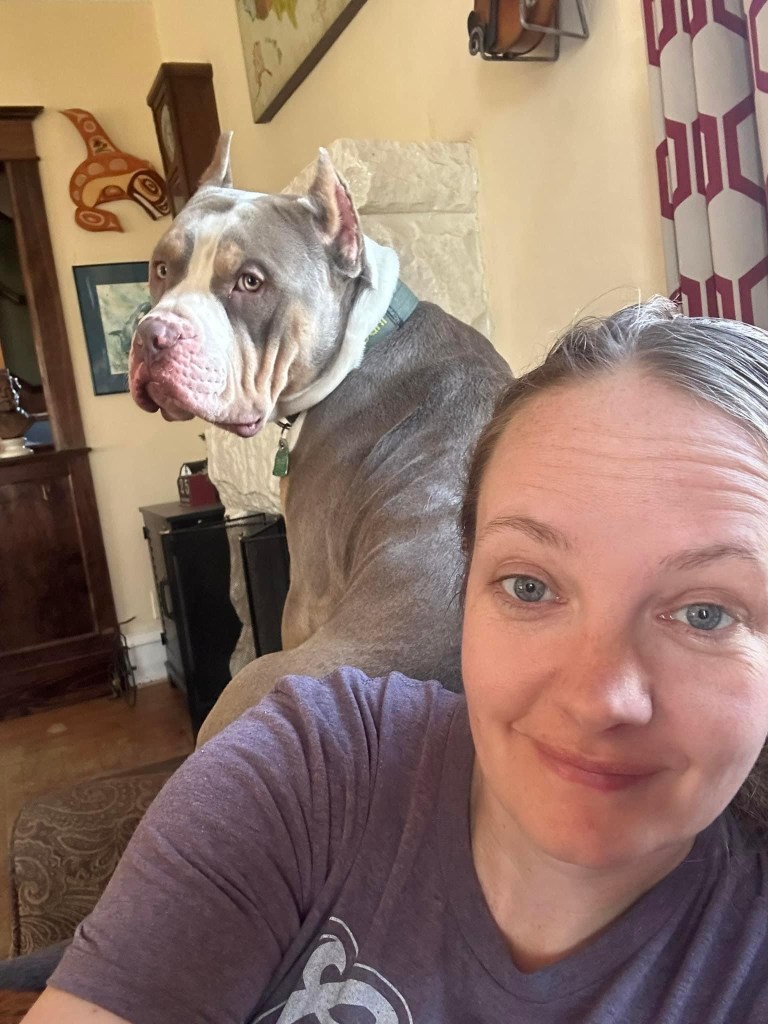
Pamela Merrell is in her second year, double-majoring in political science and creative writing. Pamela lives in Roundup, where her kids call her “bruh.”
 The Rocky Mountain Review